Me, Again

When I was four years old, my mother heard my voice change from down the hall.
I was an imaginative child, always talking, always in a world of my own, always narrating some story to myself or to the air or to whoever I thought might be listening from the other side of the room. But this was different, she says. The tone was different. The rhythm was different. The voice was not a little girl’s voice.
She walked down the hall and found me sitting on the floor, talking to no one.
But I was not speaking English.
I was speaking German.
My mother recognized it immediately. She didn’t speak German, not fluently, but she knew what it sounded like, and she knew enough to know a four-year-old American girl who had never left the country and had never been taught German should not be sitting on a carpet speaking it like she had somewhere to be.
She said my name sharply and I stopped. Just stopped, like someone had turned off a radio.
“What are you talking about?” she asked me.
And I told her, very matter-of-factly, “I was talking about when I was a bigger girl, and you and me were together in a camp. I was your mommy.”
My mother still talks about this sometimes. She brings it up in that half-serious, half-not way, like a story you tell at holidays that everyone laughs at but nobody really explains.
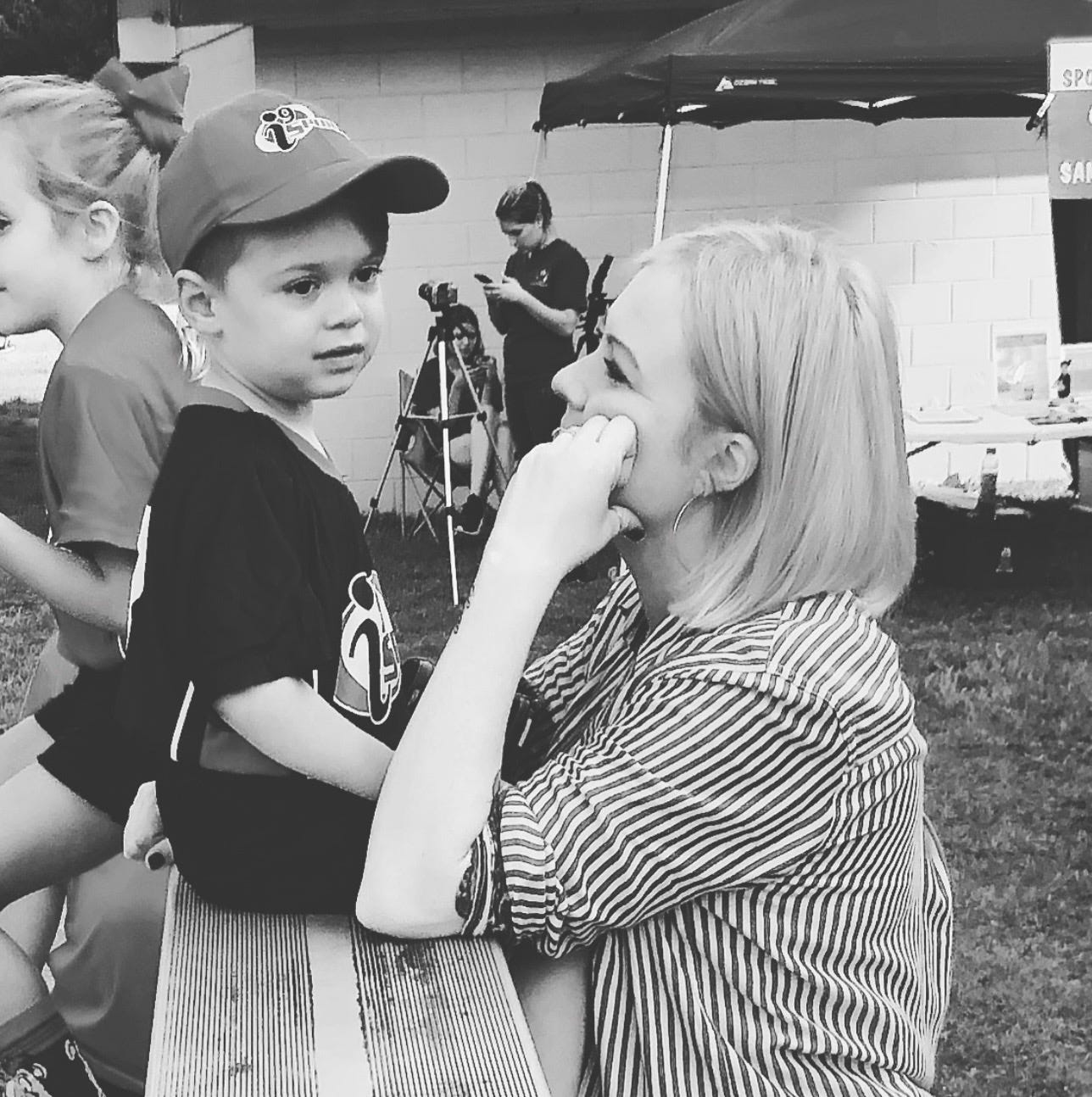
When my son was little, he talked about a lot of things too. Some of it was just kid stuff. Some of it was beyond the veil, as they say, though I don’t like to get too weird about these things in polite conversation.
This is a short fictional story I wrote that I might turn into something more someday.
I hope you enjoy it. G
Me, Again
When my son finally started talking, he did not say “Mom.”
He said, very clearly, “I’ll have the eggs, soft, if you don’t mind. And the paper. I like the paper in the morning.”
He was ten years old.
For ten years, he had said almost nothing at all. A word here and there, a sound, a hum, a meltdown in the cereal aisle, the sound of his hands hitting the wall when the world got too loud. For ten years, I learned to read eyebrows, breathing patterns, the way his left foot tapped when he was overwhelmed, the way he pressed his forehead into my arm when he needed pressure, when he needed me, when he needed the world to stop being so bright and sharp and fast.
For ten years, his father slowly packed his things in invisible ways. First it was working late, then it was sleeping on the couch, then it was not coming to doctor’s appointments, then it was not coming home at all. People like to think abandonment is a dramatic event with a suitcase and a slammed door, but sometimes it is just a man who cannot compete with a child who needs everything, and a woman who will give it.
So it was just me and him for a long time. Me and a boy who did not talk but who understood everything.
And then one morning, he started.
“I like the way the newspaper smells,” he told me, very seriously, like a small, retired man. “It smells like ink and mornings.”
We did not get the newspaper.
He began cutting his pancakes very carefully, in small squares, the way my grandfather used to cut his ham. He would sit at the table and talk about interest rates and bridges and weather patterns and a war that ended long before he was born. He talked about Austria a lot, though he had never been there. He talked about a house with a green door and a drawer in a desk where important papers were kept.
Sometimes he talked about a pipe.
“I’ve misplaced my pipe,” he would mutter, patting his pockets, annoyed. “I always misplace my pipe when there’s something important to think about.”
He did not have a pipe. He had never had a pipe. He was ten and liked dinosaur documentaries and string.
I did what all modern mothers do when something is too strange and too big and too terrifying to hold alone. I went on the internet at two in the morning.
That is where I found him. Another parent. Another single parent. A father, this time. He had a daughter who had not spoken for years and then, around the same age as my son, began speaking in full, formal sentences about places she had never been and people who were long dead. She talked about trains and uniforms and a river and a blue house and a brother named Lukas. She spoke English, but sometimes she slipped into German, which she had never been taught.
We wrote to each other for a long time before we met. There is a very specific kind of loneliness that belongs to parents of children who live slightly to the left of reality. You love them so much you could split in half from it, but you are also so tired and so scared all the time that you sometimes feel like a ghost in your own life. When we met, we did not fall in love right away, but we recognized each other immediately. Which is sometimes more important.
The strange part was not that our children were similar.
The strange part was that they seemed to know each other.
Not in the way children usually know each other, with games and cartoons and shared snacks, but in the way two old men might nod at each other across a train platform, like, Ah. You too. You remember.
One night, my son said, very calmly, while sorting his Legos by color, “We have to go to Austria.”
I laughed, because single mothers do not just go to Austria.
He did not laugh.
“There is a house,” he said. “Green door. Desk. Top drawer. We left things there. We will need them if we are going to stop him.”
“Stop who?” I asked.
He looked at me the way you look at someone who is asking a question they already know the answer to.
“The president,” he said quietly. “He is going to do something catastrophic. We tried to stop it before. We did not do enough. That is why we are here again.”
Me, again.
That is what he called it sometimes when he talked about it. Not reincarnation. Not past lives. Just, “Me, again,” like it was a sentence that kept getting rewritten but was somehow still the same sentence.
The other parent and I did something that, if you had told me ten years earlier I would do, I would have said you were insane. We took them to Austria.
The house was real.
Green door. Narrow street. A desk against the wall. And in the top drawer, exactly where they said it would be, were papers and photographs and a small, old pipe.
My son picked it up very gently, like it belonged to him.
“I told you I’d misplaced it,” he said.
And then he looked at the photographs for a very long time. Children. Groups of them. Some with stars sewn onto their coats. Some in uniforms. Some standing in front of buildings that I recognized from history books.
Over the next few days, we found more families. Not by accident. The children seemed to find each other the way magnets find each other in a drawer full of junk. A girl in Prague. A boy in Berlin. Another in Warsaw. Quiet children. Late talkers. Children who spoke like they had already been here before and were a little bit tired but very determined.
They did not talk about it like a fantasy.
They talked about it like a job.
“We didn’t finish it,” one of them said. “So we came back.”
“To do what?” I asked.
They all looked at me with a kind of gentle patience that I had seen before in nurses and very old people.
“To try again,” my son said. “We always try again.”
I used to think my job was to teach my son how to live in this world. How to talk, how to tie his shoes, how to order food, how to survive middle school, how to be okay in a world that is not built for brains like his.
Now I think maybe my job is just to drive him where he needs to go and make sure he remembers to eat, because he is very busy trying to save the world.
And sometimes, in the morning, he sits at the table, very small and very old at the same time, reading a newspaper that we now have delivered just for him. He folds it carefully, smells the ink, and shakes his head at whatever terrible thing humans are doing now.
“We really must stop doing this to each other,” he says.
Then he looks up at me and smiles, and for a moment he is just my boy again.
“Don’t worry,” he says. “We’re working on it.”
Me, again.
Beautiful, haunting, and hopeful 🙏
Gripping, hopeful and maybe more true than reality.